

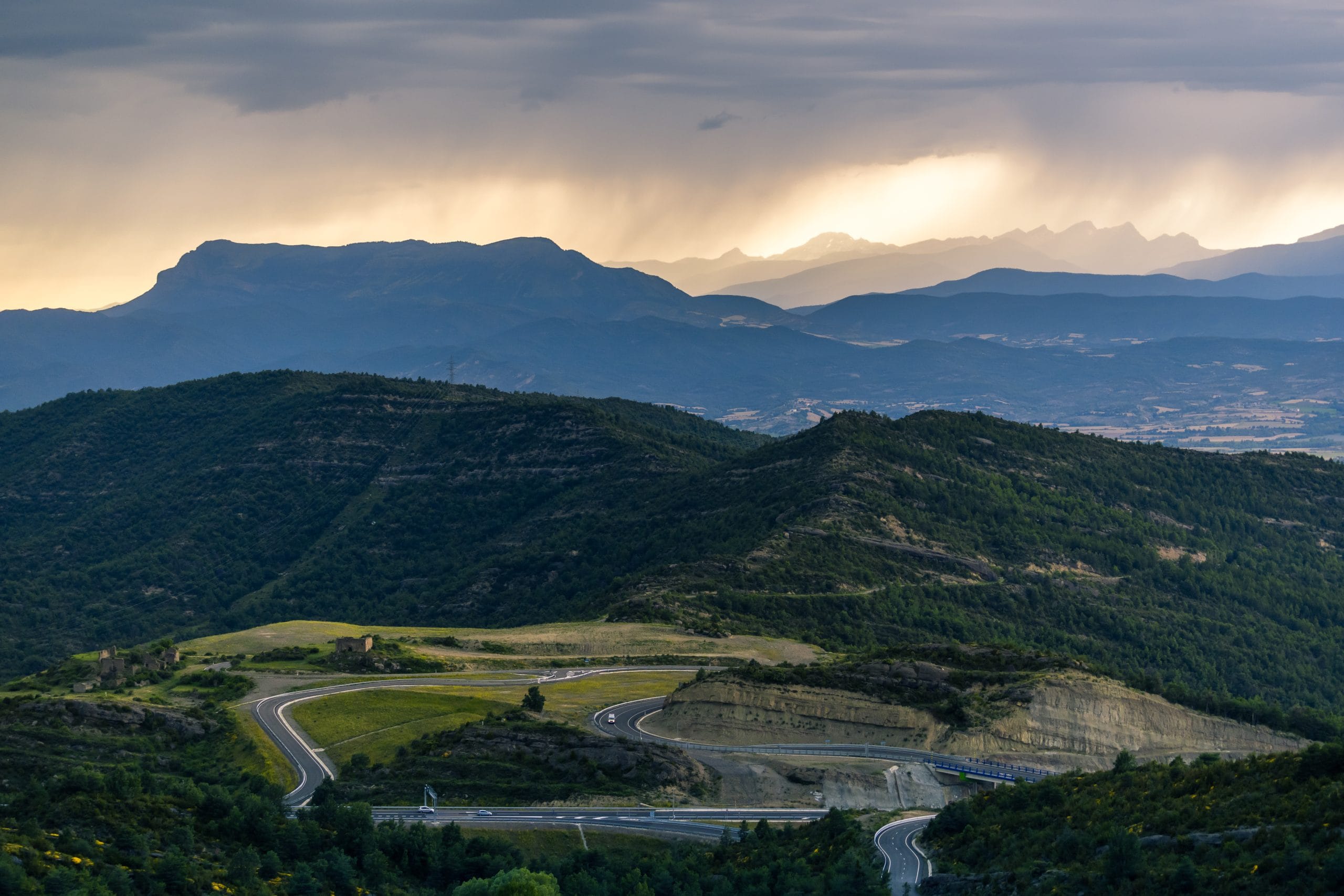
15 Jan Pyrenees
Eight BSBI members flew to Barcelona to join Teresa Farino, who has been leading wildlife tours in the Catalan Pyrenees since 1999. During the week we recorded almost 600 species of vascular plant, including several Pyrenean endemics and many which are common in Spain but becoming increasingly scarce in Britain.
After disembarking from our respective aircraft into the searing heat of the Barcelona mid-afternoon, our leader whisked us rapidly north-westwards to the cooler climes of the mountains. En route we passed the conglomerate massif of Montserrat, its jagged silhouette resembling some great prehistoric monster stranded in the arid plains, arriving about two hours later at our base in Prullans de Cerdanya.
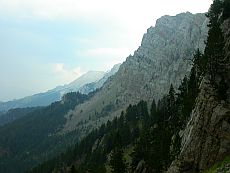
Serra del Cadí
The Cerdanya is a broad, high-altitude plain formed by the river Segre, lying southeast of the Principality of Andorra; it is hemmed in by the limestone Serra del Cadí to the south and the siliceous mountains rising to the French border to the north. Much of the area to the south of the river lies within the Cadí-Moixeró natural park.
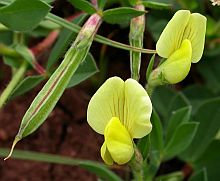
Dragon's-teeth
Tetragonolobus maritimus
After ‘high tea’ in the hotel garden, we took a leisurely stroll in the foothills behind the village. A Cuckoo called in the distance and a Western Whip Snake basked in the last of the afternoon sunshine. The Bristol contingent soon recognised Allium sphaerocephalon (Round-headed Leek) and Scirpoides holoschoenus (Round-headed Club-rush), with the bright yellow flowers of Tetragonolobus maritimus (Dragon’s-teeth) completing a trio of West Country rarities. However, the drooping heads of the grass Melica ciliata ssp. ciliata (Hairy Melick), the three-lobed leaves of Hepatica nobilis (Hepatica) and Galium maritimum, an unusually brown-flowered bedstraw, soon told us that we were definitely no longer in Britain.
Salvia pratensis (Meadow Clary), as during the whole of the week, was absolutely everywhere, though curiously unlike in our own country all the plants appeared to be hermaphrodite, with no male-only plants observed. Butterflies were abundant, with the Adonis Blue being particularly striking, while the crystal clear song of the Nightingale cut through the increasing stillness of the now approaching dusk. On the way back to Prullans, we identified Tordylium maximum (Hartwort) by the roadside.
We could hardly complain to the hotel management, but we were woken at daybreak by the rich luscious notes of a Golden Oriole. After breakfast we took a short drive in the direction of the village of Orden. A Hoopoe swooped across the road as a couple of dozen Black Kites circled above trying to gain the thermals. Below the village, the dry and dusty south-facing hillside was dominated by a scrub of Buxus sempervirens (Box) and Juniperus communis ssp. communis (Common Juniper), with a rich calcareous community clinging tenaciously to the shallow rocky soils. Botanical highlights here included Linum narbonense (Beautiful Flax), Eryngium campestre (Field Eryngo), the bronze-flowered goat’s-beard Tragopogon crocifolius and Dipcadi serotinum (Dipcadi), looking every bit like a ‘brown bluebell’. The entomologically minded marvelled at a Spanish Swallowtail and the sheer abundance of Black-veined White butterflies, now extinct in Britain.
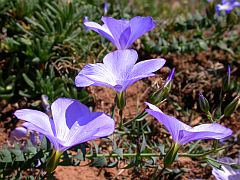
Beautiful Flax
Linum narbonense
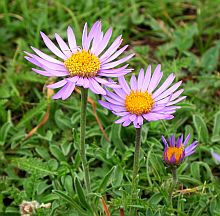
Alpine Aster
Aster alpinus
A second roadside halt by a dung heap and a couple of small puddles proved to be the lepidopterist’s nirvana, hosting Wood White, Glanville, Spotted and Knapweed Fritillaries, White Admiral and hoards of Silver-studded Blues. However, it was the botany that we had come for, and having admired such eye-catching species as Campanula persicifolia (Peach-leaved Bellflower) and Digitalis lutea (Straw Foxglove), we set off to explore the adjacent scrub, where a rich xerophytic flora included Carex humilis (Dwarf Sedge), Trinia glauca (Honewort), Aster alpinus (Alpine Aster) and Cotoneaster integerrimus (Wild Cotoneaster), although the pale-lemon flowers of the pheasant’s-eye Adonis aestivalis attracted the most attention.
Orden lies at an altitude of 1,490m, and we climbed gently from here to the next village, Talltendre. As we passed onto more acidic rock, the flora began to change, with Silene nutans (Nottingham Catchfly) giving way to Potentilla argentea (Hoary Cinquefoil), Asplenium septentrionale (Forked Spleenwort) and Plantago maritima ssp. serpentina (Fleshy Plantain). Dark Green Fritillary butterflies fluttered past the glaucous fruiting stems of Arabis glabra (Tower Mustard) along a trackside blue with the hue of Centaurea cyanus (Cornflower). Beyond Talltendre, we came upon haymeadows with an altogether more luxuriant vegetation: heads of Trollius europaea (Globeflower) peppered fields now dominated by Persicaria bistorta (Common Bistort), interspersed with Anthericum liliago (St Bernard’s Lily), and Gentiana lutea (Great Yellow Gentian). As we retraced our steps, we paused briefly to view a Woodchat Shrike which had assumed a sentinel position atop a dead tree.
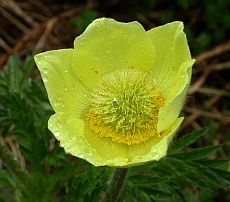
Alpine Pasque Flower
Pulsatilla alpina ssp. apiifolia
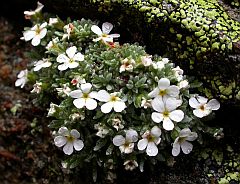
Androsace vandellii !
As we climbed towards the Clot de l’Orri, we noticed Gymnocarpium dryopteris (Oak Fern), while the yellow-flowered Pulsatilla alpina ssp. apiifolia (Alpine Pasque Flower) vied with abundant Lychnis alpina (Alpine Catchfly) – more plants in a hundred metres than the entire British population! – and the delightful yellow-flowered stonecrop Sedum alpestre for eye-catching beauty. Less colourful, but no less novel, was the stately umbellifer Molopospermum peloponnesiacum ssp. peloponnesiacum (“repeat after me.”, said our leader).
The path ended in a magnificent corrie containing a peatbog, where the flora included Polygala alpestris (Mountain Milkwort), Veronica alpina (Alpine Speedwell), V. bellidioides (Violet Speedwell, not previously recorded in the area), Pinguicula grandiflora (large-flowered butterwort), Loiseleuria procumbens (Trailing Azalea), and that other British rarity – if indeed it is native here – Homogyne alpina (Alpine Colt’s-foot).
Those who climbed the final kilometre or so towards Andorra were rewarded with sightings of Alpine Marmot, as well as Primula integrifolia (Entire-leaved Primrose), Juncus trifidus (Three-leaved Rush), Bartsia alpina (Alpine Bartsia), the rock-jasmine Androsace vandellii and the rare saxifrage Saxifraga aspera, endemic to the Pyrenees. Then the heavens opened and the descent back to the road completed the resemblance to the Scottish hills (“I’m sure there was a cairn here…”), but nevertheless, we all agreed that it had been a splendid day


No Comments